

Key takeaways
- 3PL services can give shippers access to a broad network of LTL carriers without managing dozens of individual carrier contracts.
- Adding a 3PL connection can improve freight pricing, increase shipping capacity, and simplify expansion into new markets.
- Pacejet allows you to rate shop direct carriers and 3PL services within the same shipping workflow to optimize multi-modal shipping.
Less-than-truckload (LTL) shipping has become increasingly complex for manufacturers, distributors, and ecommerce businesses. As you consider how to expand your LTL shipping options and stay competitive, you may be wondering: Should I use carriers directly, work with a third-party logistics provider (3PL), or a mix of both? And, if I go with a 3PL, can my systems support that?
This article provides a comprehensive overview of the LTL shipping challenges you can solve with a 3PL, the benefits you can expect, and the most practical way to integrate 3PLs with your parcel and freight shipping workflows.
Table of contents
The challenge of managing LTL freight capacity and costs
Recent market data shows shipment volumes remain soft while freight spending has not fallen at the same pace. Many shippers are moving less freight but still seeing firm rates and rising accessorial costs.
Several structural shifts are also making day-to-day LTL operations harder to manage:
- Density-based NMFC classification updates mean shipment dimensions and data accuracy now play a bigger role in pricing.
- Carrier networks are still adjusting after major industry changes like the Yellow shutdown.
- Accessorial charges and reclassification risks are becoming more common when shipment data is incomplete.
Despite freight shipping uncertainty, customers still expect fast delivery, reliable service, and predictable shipping costs. That means logistics teams need flexibility. They need access to more carrier options without creating more operational complexity.
How can I expand LTL freight options and flexibility?
One way many organizations can overcome these challenges is by working with third-party logistics providers (3PLs). 3PLs allow less-than-truckload freight shippers to access broad carrier networks through a single provider rather than maintaining individual relationships and negotiating rates with dozens of carriers.
By shipping LTL freight through this expanded network, you can increase flexibility and strategic control needed to scale complex shipping operations.
When combined with a multi-carrier, multi-modal shipping automation solution like Descartes Pacejet, which also integrates with your ERP, 3PL services become even easier to manage. You can use 3PL shipping services alongside your existing parcel and freight carriers on a single platform, automatically selecting the best option for each shipment.
What is a 3PL for shipping?
A third-party logistics provider for shipping acts as a transportation intermediary; a middleman that connects shippers to its carrier network or shipping fleet services. Though many 3PLs offer warehouse services, you can also skip the warehousing and only use a 3PL for shipping, billing, carrier dispute management, or other services.
3PLs often maintain relationships with dozens or hundreds of carriers worldwide, negotiating discounted rates based on shipping volume. Through this shipping network, they can offer highly flexible and cost-effective shipping options that are typically not available to small or midsized businesses.
Why do many companies use a 3PL for shipping but not warehousing?
Some businesses take advantage of 3PL shipping services but prefer to keep warehouse operations in-house for the following reasons:
- Fully outsourcing to a 3PL can be more expensive than in-house fulfillment.
- Certain products require special handling to avoid damage.
- In-house fulfillment gives greater operational control and visibility.
- Customer experience is a high priority and cannot be entrusted to third parties.
Examples of best 3PLs for LTL shipping
Choosing the right third-party logistics provider for less-than-truckload (LTL) freight depends on your shipping complexity, volume, and visibility needs. The providers below all offer LTL services, integrated with Descartes Pacejet to help teams centralize rating, booking, and tracking.
Best 3PLs for manufacturing
Popular 3PLs for manufacturing companies include Mainfreight, C.H. Robinson, and Echo Global Logistics. Manufacturers typically need reliable capacity, multimodal flexibility, and support for complex freight movements. These providers are well-suited to meet those requirements:
Mainfreight
Mainfreight provides global logistics services, including warehousing, inventory management, and end-to-end supply chain support. This makes it a strong fit for manufacturers with international operations or complex distribution needs.
C.H. Robinson

C.H. Robinson is one of the largest 3PL providers in North America, offering access to a vast carrier network across LTL, truckload, ocean, air, and intermodal shipping.
Echo Global Logistics

Echo Global Logistics delivers multimodal transportation services supported by a centralized technology platform for quoting, booking, and tracking shipments.
Best 3PLs for distributors
Popular 3PLs for distributors to manage LTL shipping include BlueGrace Logistics, GlobalTranz, and Priority1.
Distributors often need consistent pricing, flexible capacity, and tools to manage frequent shipments across many destinations. These 3PL providers help distributors maintain flexibility and control without managing carrier relationships manually.
BlueGrace Logistics

BlueGrace Logistics offers technology-driven freight management and managed logistics services, helping businesses coordinate transportation and improve visibility.
GlobalTranz and Priority1


GlobalTranz and Priority1 focus on freight brokerage and transportation management, connecting shippers with large carrier networks to streamline LTL shipping.
Best 3PLs for ecommerce sellers
Top less-than-truckload shipping 3PLs for ecommerce businesses include Worldwide Express (WWEX), Unishippers, Echo Global Logistics, and C.H. Robinson.
Ecommerce businesses often need a mix of parcel and LTL shipping, along with visibility as they scale into more complex fulfillment operations. With these 3PLs, ecommerce teams can streamline inbound freight, reduce delays, and keep inventory moving efficiently across fulfillment channels.
Worldwide Express (WWEX) and Unishippers

WWEX and Unishippers provide access to carrier networks that support both small parcel and freight shipping, helping growing businesses manage different shipment types in one place.
Echo Global Logistics and C.H. Robinson
Echo Global Logistics and C.H. Robinson also support ecommerce operations with multimodal transportation services and shipment visibility tools.
Benefits of using a 3PL for less-than-truckload shipping
Using a third-party logistics company provides several advantages when shipping LTL freight:
- Instantly expands your carrier network
- Lower shipping costs with competitive rates
- Flexible capacity during demand spikes
- Easier expansion into new regions
Instantly expands your carrier network
One of the biggest advantages of using a 3PL for LTL shipping is access to a much larger carrier ecosystem and pre-negotiated shipping rates.
Instead of relying on a limited set of contracted carriers, your shipping team can tap into a broader network of international, domestic, and regional providers. Each 3PL integration may give you access to dozens or even hundreds of carriers.
This expanded network helps your organization:
- Identify better pricing opportunities
- Maintain service levels during capacity shortages
- Access specialized regional carriers
Works with your existing systems
When you connect a 3PL with multi-carrier shipping software, these expanded options appear directly in the shipping interface. Then, your team can quickly evaluate them alongside your existing shipping methods without hopping between platforms. See how this works
Lower shipping costs with competitive rates
Third-party logistics companies negotiate discounted shipping rates with their carrier partners based on shipment volume. You gain access to these discounts, and the cost savings often outweigh the management fees charged by the 3PL. If the savings are still greater than your own negotiated rates, it’s a win.
What’s the fastest way to compare shipping rates?
With so many carriers and services to evaluate, it can seem overwhelming, especially when also comparing against your existing rates. The best way to simplify rate comparison is to use a multi-carrier, multi-modal shipping platform that compares your parcel, LTL, and 3PL services on a single screen.
You should be able to automatically rate shop and compare services for each order, then select the best option, whether it’s one of the 3PL carriers or your own. Look for a tool with shipping performance reports and analytics to provide the visibility you need without resorting to spreadsheets.
Flexible capacity during demand spikes
Freight markets can become tight during busy shipping periods. When capacity is limited, having access to a larger network of carriers helps maintain delivery schedules and avoid delays.
3PL services provide additional carrier options without requiring your team to establish new contracts or integrations. This immediately increases your capacity to keep pace with shipping volume. You can scale operations as needed.
Easier expansion into new regions
Adding a warehouse in a new geographic region? Your existing LTL carriers may not cost the same or have the equipment needed to service that area. All less-than-truckload carriers are specialized by equipment and region, which means you will get better, more cost-effective shipping in some areas than others.
By using a 3PL’s carrier network, you can choose the most cost-effective, reliable carriers for each geography. Instead of negotiating rates and building new carrier relationships immediately, you can test shipping operations in the new region to see what works.
Problems with using third-party logistics for LTL shipping
Most 3PL providers do not offer real-time, API-based integrations with ERP systems. They also rarely support a broad mix of parcel and direct LTL carrier connections in one place.
That creates a gap for logistics teams. You end up with fewer carrier options, which can drive up shipping costs. At the same time, teams are forced to jump between systems or rely on manual processes just to compare rates or process shipments.
How does Descartes Pacejet simplify shipping with 3PLs?
Connecting 3PL to ERP for shipping
Descartes Pacejet™ solves the problem of disconnected 3PLs and ERPs by bringing everything into a single, connected shipping workflow via pre-built integrations. It serves as a central hub, integrating 3PL providers, your ERP, parcel, and LTL carriers within one program, so you can manage all shipping decisions in one place.
Instead of requesting freight quotes manually or switching between systems, logistics teams can compare options directly within the Pacejet interface. You can also automate shipping workflows across parcel, freight, and LTL.
Ready to see it in action? Request a demo
How does 3PL connection work in Pacejet?
Pacejet offers pre-built integrations for 20+ 3PLs. After you choose a 3PL and create an account, you can contact Descartes support to activate it in your Pacejet platform. This is a quick process. Once a 3PL connection is enabled, it appears alongside your other carriers in Pacejet.
That means you can:
- Rate shop between direct LTL carriers and 3PL services
- Compare transit times and pricing
- Select the best service for each shipment
- Automatically generate shipping labels and documents
- Tender shipments electronically to the 3PL
This unified workflow helps you reduce costs, expand carrier choice, and simplify day-to-day shipping operations. You get all the benefits of using a 3PL without the problems stemming from disconnected platforms.
Articles and demo videos to see how it works
If you want to understand how 3PL services are used inside the Pacejet platform, our knowledge base includes several detailed walkthroughs:
- A good starting point: How Descartes Pacejet™ Uses 3PL Services for Freight Quoting and Integrated Shipping Workflows.
- How quoting works: ERP-Integrated 3PL Freight Quoting (with Demo Video)
- How shipments are executed after quoting: ERP-Integrated 3PL Shipping Execution (with Demo Video)
- How shipping documents and paperwork are generated: Using Descartes Pacejet™ Self-Service Shipping Paperwork for ERP-Integrated 3PL Execution (with Demo Video)
Prefer a personal walkthrough? Request a demo
Three ways Pacejet 3PL connections improve shipping performance
1. Find the most cost-effective option
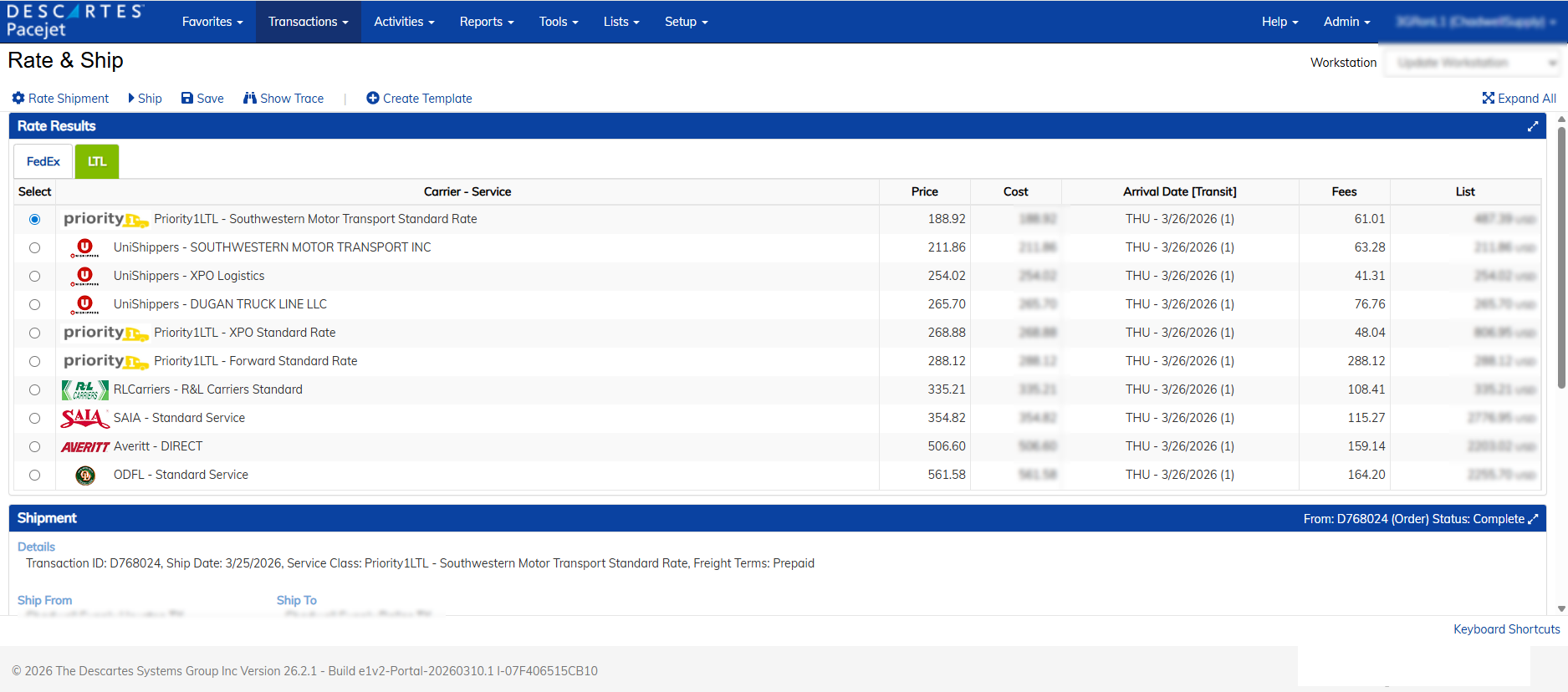
When you connect a 3PL to Pacejet, the 3PL’s services and discounted rates appear alongside your direct carrier rates. This makes it easy to identify the most cost-effective shipping option.
In the screenshot below, the 3PL UniShippers appears as a carrier with service options and quoted rates for Southwestern Motor Transport Inc., XPS Logistics, and Dugan Truck Line LLC, alongside carriers like Priority1, SAIA, and Averitt, with whom the shipper has direct accounts.
2. Avoid late shipments during peak demand
By enabling a 3PL connection (or multiple 3PLs) in Pacejet, you immediately gain access to each provider’s shipping capacity. That means you are much less vulnerable to late shipments when freight shipping markets become tight during seasonal peaks.
When selecting services to meet delivery deadlines during busy seasons, Pacejet will automatically display all 3PL carrier services alongside your direct carriers’ services. If your go-to carriers can’t make your deadlines, the system makes it easy to select the best alternative and keep your delivery promise.
3. Gain the visibility needed for shipping cost optimization
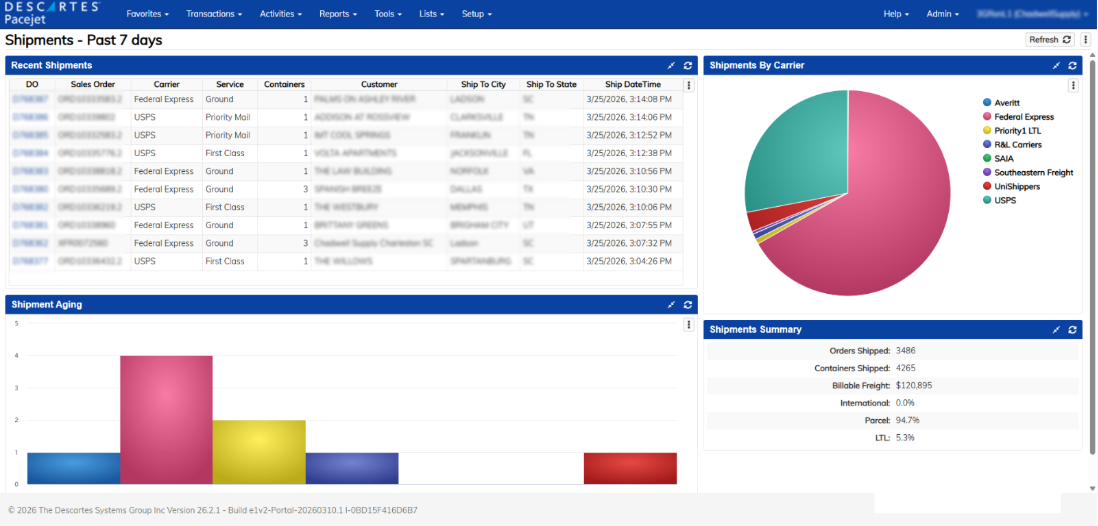
Because Pacejet aggregates data for your parcel, less-than-truckload, freight, and 3PL on one platform, you get a comprehensive overview of shipping cost drivers. No need for spreadsheets and manual calculations.
In the screenshot below, you can see a breakdown of the carrier mix used by this shipper in a week, including total billable freight and the split between parcel and LTL:
At a more granular level, you can identify cost-saving opportunities by reviewing the Shipment Savings analytics available in Pacejet. Reporting helps you quantify the impact of rate-shopping on your overall savings.
In Shipment Savings, you can see the impact of override decisions or pre-determined, “single quote” decisions on your overall freight spend. You can also look more deeply into when carriers and services win certain types of shipments with various orders, customers, geography, and more.
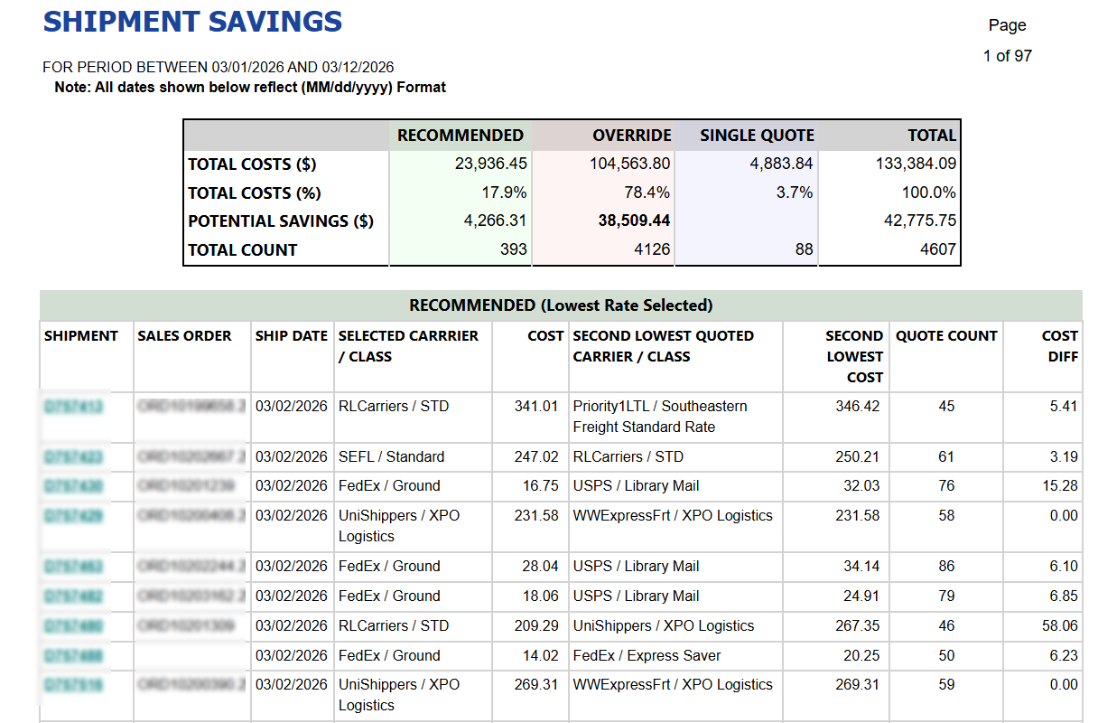
Over time, organizations often find that a mix of direct carriers and 3PL services yields the best overall freight strategy for controlling shipping costs. With Pacejet, you gain the visibility to understand what’s working and where to adjust your shipping for optimal performance.
How to get started with 3PL shipping in Pacejet
- Descartes customers, to get started, contact your account manager to discuss your goals for 3PL use and get recommendations for the best pre-integrated 3PL options to meet your needs.
- After you select a 3PL and sign up, contact support to activate the integration. You will need your new 3PL account information to activate it.
- The support team will enable your 3PL in Pacejet.
- Your new 3PL will appear with your other carrier options.
- You can start shipping with the 3PL’s services.
- Compare results alongside your existing carriers and measure savings over time.
After you start using the 3PL, your Pacejet shipping analytics and reporting tools can then help your team evaluate:
- Rate competitiveness
- Carrier performance
- Transit reliability
- Shipping cost trends
This data-driven approach will help your logistics team make the right strategic decisions to gradually expand your freight shipping strategy as your business grows.
Ready to automate 3PL, parcel, and freight shipping?
Not a customer yet? See how Descartes Pacejet connects your ERP, carriers, and 3PL partners within one platform. Discover how automated rate shopping, ERP integration, and a connected carrier network can help you reduce freight costs and scale shipping operations.

3PL freight shipping FAQs
3PL services are often useful for manufacturers, distributors, and ecommerce sellers who ship less-than-truckload freight and want to expand carrier access, improve freight pricing, increase capacity during peak shipping periods, or expand to new geographic regions.
Yes. Many logistics teams use a combination of both approaches for freight shipping. Direct carrier contracts may provide stable pricing for common routes, while 3PL services offer additional flexibility and carrier access.
You can use both direct carriers and 3PL carriers in the same shipping workflow with multi-carrier shipping software, such as Descartes Pacejet. Before choosing a shipping platform, ensure that it supports both 3PLs and your existing carriers.
Most 3PL providers do not offer real-time, API-based integrations with enterprise resource planning (ERP) systems, so it’s best to use multi-carrier shipping software as a central hub. A platform such as Descartes Pacejet connects with 3PLs, ERPs, parcel and freight carriers to automate shipping workflows across systems.
Pacejet offers pre-built integrations for 20+ third-party logistics providers for LTL freight shipping, including popular platforms such as C.H. Robinson, Echo Global Logistics, Seko, and Worldwide Express (WWEX).
Pacejet integrates directly with supported 3PL services via our API. Once configured, these providers appear alongside other shipping carriers in the shipping workflow, allowing teams to rate shop and generate shipment documentation automatically.