
Key takeaways:
- Retail and marketplace chargebacks for bad labels are rising sharply, and unscannable barcodes are one of the most common causes.
- Descartes Pacejet™ 26.5 rebuilds how standard shipping labels render barcodes, fixing the resizing and distortion issues that cause scan failures at receiving docks.
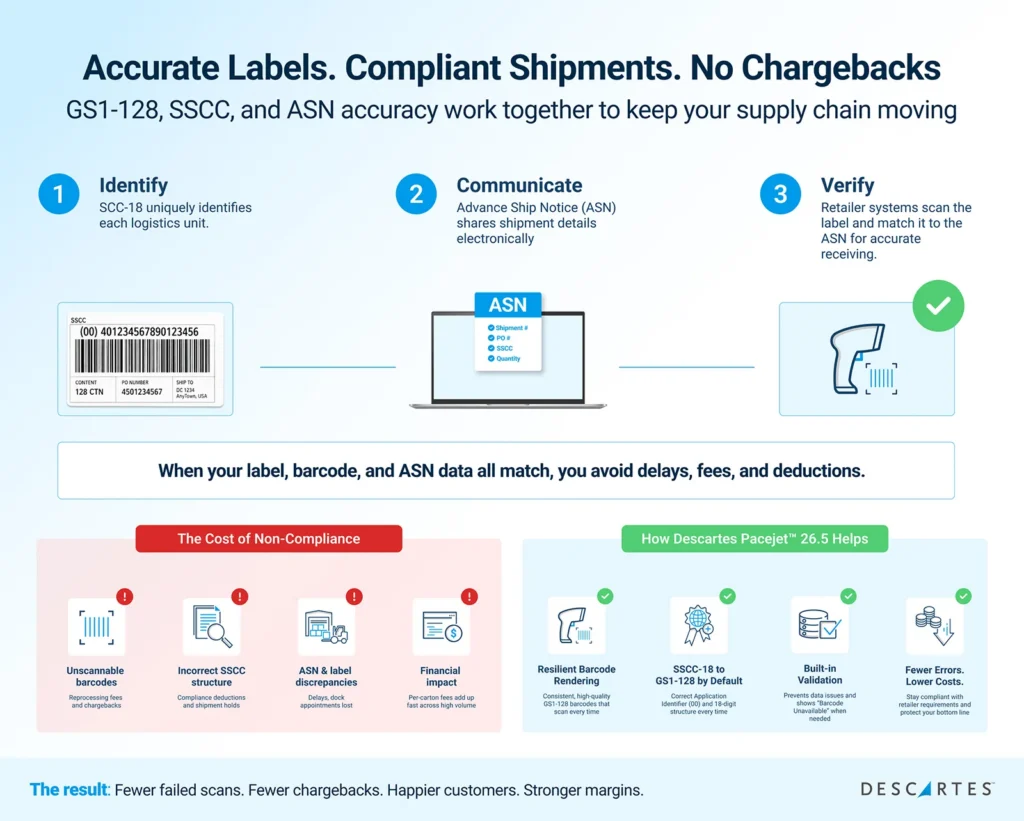
- New SSCC barcodes are generated to GS1-128 standards by default, with the correct 18-digit SSCC structure, check digit, and GS1 Application Identifier (00) every time.
- If label data does not fit safely on a barcode, Pacejet now shows a clear “Barcode Unavailable” message instead of printing a broken or invalid barcode.
- The result: fewer failed scans, fewer chargebacks, and less time spent troubleshooting labels that “look right” but don’t scan right.
Marketplaces maintain strict standards for barcodes
If you ship to Amazon, Walmart, Target, or any retailer with a routing guide, you already know the drill: one bad barcode and a chargeback shows up on your next payment. It doesn’t matter if the label looked fine on your screen. If it doesn’t scan clean at the dock, you pay for it. That problem is getting more expensive.
Target
In May 2025, Target expanded its Perfect Order Program by adding Physical Barcode Accuracy and ASN Accuracy as scored compliance metrics, assessing $0.75 per non-compliant carton for barcode and ASN violations, with ASN violations carrying a minimum fine of $100.
Walmart
Walmart has been tightening its own standards, too. As of August 2025, food and beverage suppliers must transmit enhanced traceability data through the ASN, with GS1-128 case labels and SSCC-18 pallet labels linked directly to that ASN, and Walmart has folded traceability into its Supplier Quality Excellence Program (SQEP) alongside its ongoing FSMA compliance requirements.
And, as of 2026, for Walmart’s two core programs: OTIF (On-Time In-Full) and SQEP (Supplier Quality Excellence Program), “Failure to comply results in chargebacks of 3% of cost of goods on non-compliant shipments” (Distribution Alternatives).
Amazon
On January 1, 2026, Amazon stopped offering prep and item-labeling services for U.S. Fulfillment by Amazon shipments, so sellers must now ensure affected inventory is prepared and labeled before it reaches Amazon, adding another layer of responsibility to already complex warehouse labeling workflows.
How much are bad barcodes costing retailers?
These changes reflect a broader trend: retailers are evaluating not just whether a label exists, but whether it scans correctly and matches the shipment data they receive electronically. Even small per-carton deductions add up fast, and they’re only part of the picture. Industry estimates put total retailer chargebacks to suppliers at more than $5 billion a year, with labeling, ASN, and routing guide violations among the largest contributors.
While vendors definitely know the rules, barcode rendering is more fragile than it looks, and small things, like a longer purchase order number, a lowercase letter, or a slightly different label layout, can quietly turn a “correct” barcode into one that won’t scan. That’s exactly the problem Descartes Pacejet 26.5 was built to fix.
How does Descartes Pacejet 26.5 improve GS1-128 label compliance?
More resilient barcode rendering, so labels don’t distort under real-world data
Pacejet 26.5 changes how barcodes are rendered on standard label templates. In plain terms: the barcode you see on screen is the barcode that will actually scan at receiving.
Previously, certain combinations of label layout, field length, and data content could cause a barcode to resize unpredictably or exhibit a “gray scaling” effect, both of which hurt scannability. That’s now fixed. Barcodes render consistently across supported layouts, and they hold up better when a field includes lowercase letters or special characters, which used to be a common source of scan failures.
SSCC barcodes generated to GS1-128 standards by default
Serial Shipping Container Codes (SSCCs) are central to many retailer logistics-label and ASN workflows, and they have to be built exactly right: the correct 18-digit SSCC structure, check digit, and GS1 Application Identifier (00), no exceptions.
Pacejet 26.5 updates the standard label templates, so SSCC values are generated with the correct GS1-128 encoding automatically, rather than depending on manual template configuration to get it right. New standard templates roll out first in a controlled test mode, with a safe migration path for customers already using the older format.
Built-in validation with clear fallback text instead of a broken barcode
Sometimes a field, like a long purchase order number or an ecommerce order ID, is simply too long to render as a clean barcode. In the past, that could produce a barcode that looked present but failed to scan. It was one of the more frustrating causes of chargebacks because everything appeared fine until it was rejected at the dock.
Pacejet 26.5 adds validation limits for key fields (i.e., postal code, purchase order, ecommerce order, and store number) and, when data exceeds what can be reliably encoded, prints clear “Barcode Unavailable” text instead. Your warehouse team can see and fix the issue before the shipment goes out, instead of finding out about it in the form of a chargeback weeks later.
Why this matters for your bottom line
Every one of these changes maps directly to a chargeback category retailers and marketplaces are actively enforcing right now: unscannable barcodes, incorrect SSCC structure, and label data that doesn’t hold up under real shipping conditions. We fixed the barcode engine at the source, which means your team can now spend less time investigating “why did this get rejected” and less money on per-carton penalties that add up fast across high volume.
Not a Pacejet customer but need to fix your barcodes?
If retailer or Amazon chargebacks are cutting into your margins, our team can walk you through exactly how Pacejet 26.5 keeps labels scan-ready before they ever leave the warehouse. See how Pacejet works with your ERP to optimize shipping operations.
GS1-128 and barcode compliance FAQs: Pacejet 26.5
A GTIN (Global Trade Item Number) identifies a product and uses the same number regardless of how many units are shipped. An SSCC identifies one specific logistics unit, such as a single case or pallet, and is unique to that shipment. A carton label can carry both: the GTIN identifies what’s inside, and the SSCC identifies the physical unit moving through the supply chain.
The SSCC printed on a GS1-128 label is also included in the Advance Ship Notice (ASN) sent to the retailer ahead of the shipment. When the carton arrives, the receiving system scans the barcode and matches the SSCC against the ASN record. If the barcode doesn’t scan cleanly, or the SSCC on the label doesn’t match the ASN, that mismatch, not just a printing issue, is often what triggers a compliance deduction.
No. Existing standard templates continue to work as they do today. Pacejet 26.5 introduces the improved, more resilient barcode rendering and GS1-128 encoding in new standard templates, rolled out first in a controlled test mode, with a migration path for customers who want to move to the updated templates.
The 26.5 update focuses on Pacejet’s standard label templates. If you’re using the self-service paperwork editor or Pacejet Trading Partner Compliance to customize labels, the same underlying barcode rendering improvements apply to barcodes generated within Pacejet.
No. Amazon’s January 2026 change affects FBA prep and item labeling specifically, but GS1-128 and SSCC compliance apply broadly, across Walmart, Target, and most major retailers with routing guide and ASN requirements.
Learn more
- What is a GS1-128 barcode? — Learn how GS1-128 barcodes encode shipment data, including SSCCs and other GS1 identifiers used throughout retail supply chains.
- Understanding Serial Shipping Container Codes (SSCCs) — See how SSCCs uniquely identify pallets and logistics units, and why they’re required by many retailers.
- GS1 Logistics Label Guidance — Learn how GS1 logistics labels, SSCCs, and advance ship notices (ASNs) work together to improve receiving accuracy and supply chain traceability.